
Disclaimer: This article is provided for educational and informational purposes only. While every effort has been made to ensure the information is accurate and up to date, insurance laws, regulations, policy language, and carrier guidelines can vary from state to state and from carrier to carrier. This content should not be considered legal, financial, or insurance advice. Always consult a licensed insurance professional in your state regarding your specific situation.
A client rarely wakes up hoping to talk about insurance. They wake up hoping their car starts, their home is safe, their teenager gets where they are going, and a storm does not become a financial crisis.
That is the job behind the policy.
The most durable personal-lines agencies do not confuse “we answered the phone” with a client experience. They reduce uncertainty before a loss, make choices understandable at renewal, and stay useful when the carrier’s claims process takes center stage. That is especially important in a market where price pressure is real: J.D. Power reported that clear explanations and options can materially improve satisfaction after a home premium increase. Its 2025 Home Insurance Study found a 184-point satisfaction gap between customers who did and did not understand an increase and receive options.
The headline is deliberately human, not a claim that every insured has said these exact words. Think of these seven items as evidence-informed client expectations and the friction points agency teams can actually remove.
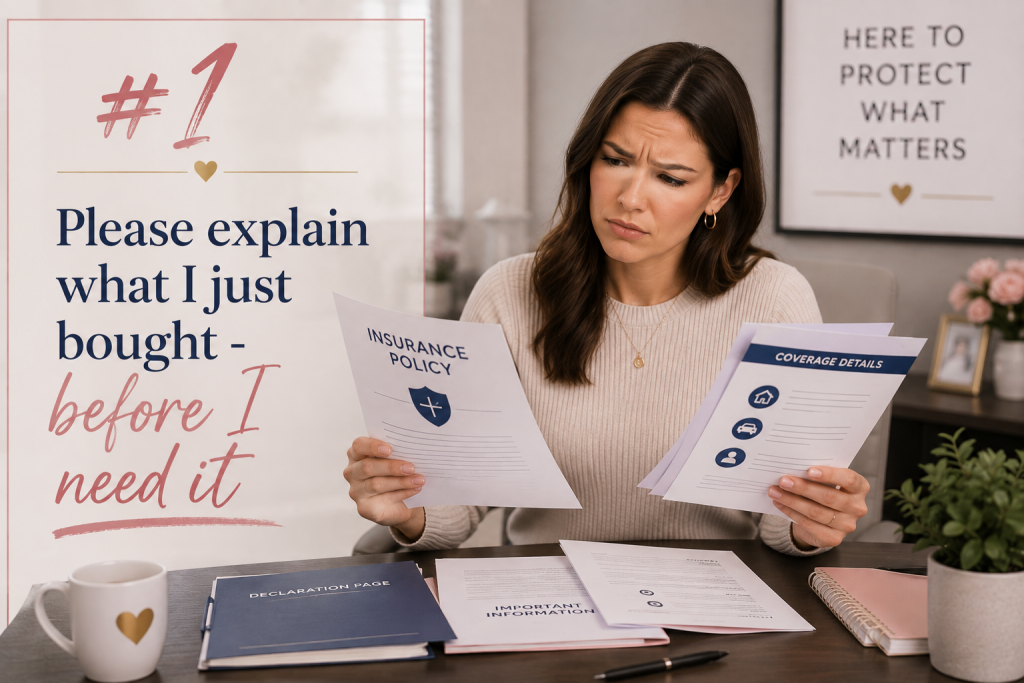
Clients do not need a policy-form lecture. They do need a plain-English map. The NAIC explains that a declarations page identifies the policy term, insured, vehicle(s), limits and other key information, while the policy itself contains rights, duties, definitions, exclusions and limitations. That distinction is an agency service opportunity.
A declarations page is a dashboard, not a coverage promise. A useful review translates the dashboard into decisions:
- Auto: liability limits; uninsured/underinsured motorist coverage where offered; medical payments or PIP where applicable; collision and other-than-collision deductibles; rental reimbursement and towing if purchased.
- Homeowners: dwelling limit, deductible(s), personal-property coverage, liability, loss-of-use/additional-living-expense provisions and notable endorsements or limitations.
- Renters and condo/townhome: personal property, personal liability, loss of use, deductible, and—critically—the client’s responsibility compared with the association’s master policy.
- Umbrella: required underlying limits, listed drivers/household members, covered locations and any carrier-specific conditions.
Avoid shorthand that creates false confidence. “Full coverage” is not a standard coverage package; the NAIC’s auto shopping tool explicitly says policies are made of different coverages. Instead of saying, “You’re fully covered,” say, “Here is what this policy shows you purchased, the limits and deductibles shown on the declarations page, and the questions I recommend we review.”
The 12-Minute Policy Translation
Build this into new-business onboarding and every meaningful change:
- Send the declarations page securely and ask the client to verify names, garaging address, vehicles, drivers, mortgagee/lienholder and contact details.
- Hold a short call or video meeting. Use one sentence per major coverage: what it generally protects, the shown limit/deductible, and one decision point.
- Email a recap headed “What we reviewed / What you chose / What to revisit.” Attach the carrier documents; do not substitute an informal recap for the policy
- Record date, participants, facts supplied, options presented, selections/declinations and follow-up date in the agency management system.
Talk track: “I’m not going to read the policy at you. I do want to make sure the declarations page matches your life and that you know the three numbers most likely to matter in a tough moment: your liability limits, your deductibles and your coverage for temporary living or transportation—if those coverages are on your policy.”
Quick win: Add a one-page “How to read your declarations page” guide to every welcome email. Link to your carrier portal and invite a reply with one question. Clarity is service, not a value-add reserved for a claim.

A pristine renewal record can still hide a changed household. A new licensed teen, a move, a paid-off auto loan, a roommate, a newly acquired dog, a remodeled kitchen, a short-term rental plan, or an adult child moving back home can change the questions worth asking. The agency does not need to diagnose every risk; it needs a consistent trigger system and a respectful way to ask.
This matters because personal policies are built on facts. The NAIC notes that auto declarations include items such as covered vehicles, lienholders, coverages, limits, premium, risk classifications and garaging information. Incorrect or stale facts are not a harmless CRM issue. They can create surprises in rating, underwriting or claims.
For condos and townhomes, resist the temptation to call every policy “homeowners.” Association documents and unit-owner responsibilities vary. Ask for the declaration pages or insurance section of the association documents, then identify questions for the carrier: What portion of interior building property is the unit owner responsible for? Is coverage based on bare walls, single entity or all-in concepts? Is loss assessment available, and what are its terms? Do not infer the answer from the word condo or townhome.
Agency workflow: life-event triggers, not annual nagging
Use a short, permission-based check-in at onboarding, renewal and after a service contact. Route “yes” answers to a licensed team member or the appropriate carrier workflow.
Client check-in template
Subject: Two-minute insurance check-in
Hi [First Name], before we finalize your renewal, has anything changed with drivers, vehicles, address/garaging, household members, pets, renovations, mortgage/loan status, home-based activity, rental plans or association requirements? A quick reply—even “no changes”—helps us make sure we are reviewing the right facts. We’ll explain any options; you decide what fits your needs and budget.
Operational checklist
- Create coded triggers for new driver, move, vehicle purchase/lease, loan payoff, renovation, household change and condo/HOA document request.
- Make the “why we ask” visible: accuracy, options and avoiding surprises—not a pretext to sell.
- Require source-document review where a carrier requires it; save documents according to your retention and privacy practices.
- Never promise that a reported change is covered or bound until carrier confirmation and applicable policy requirements are satisfied.
A good question is memorable because it sounds like care: “What has changed since we last talked that would make this policy less useful to you?”
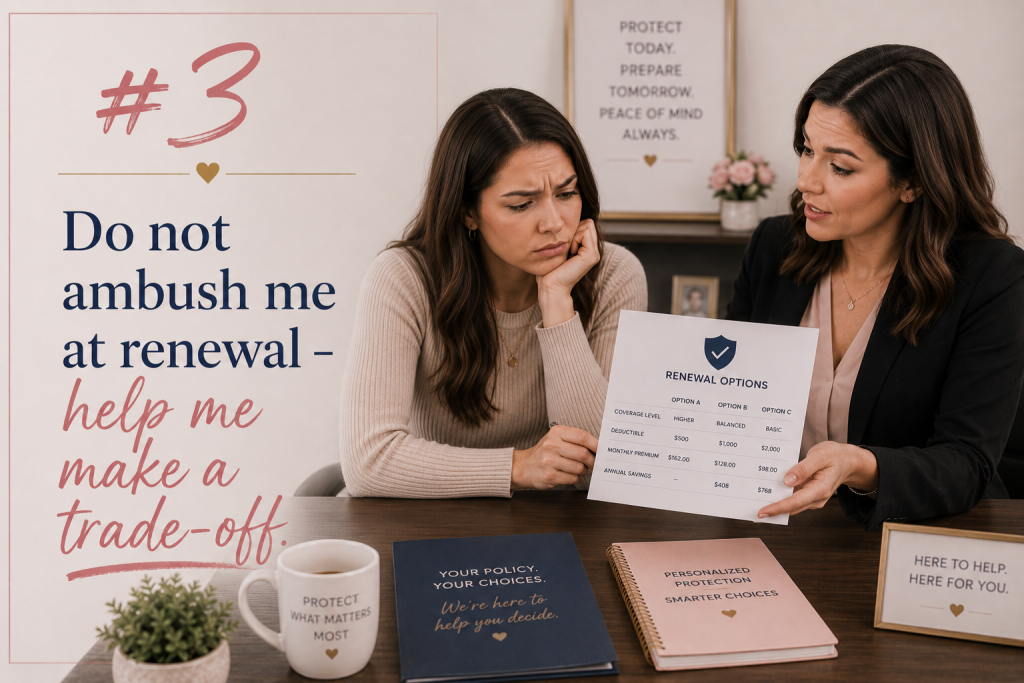
When a renewal premium jumps, clients often hear only one thing: my agent did nothing. Your team may not control the carrier’s rate filing, underwriting appetite or catastrophe exposure. You do control when you call, whether you explain the information available, and whether the client sees choices before the due date.
That distinction is valuable. In J.D. Power’s 2025 home study, customers who experienced an increase but fully understood its reason and were offered options reported higher satisfaction than customers who had no increase. That is not an instruction to spin bad news; it is evidence that proactive explanation plus real choices matters.
Agency workflow: the 45–21–7 renewal runway
45 days out: identify material changes in premium, deductible, coverage or underwriting requirements. Segment accounts requiring outreach rather than trying to call everyone with the same script.
21 days out: send a personalized renewal preview. State the current and renewal premium, due date, key policy changes shown in carrier documents, and a clear appointment link. Do not speculate about a rate change; use carrier-approved, fact-based language.
7 days out: confirm the chosen path and payment/required documents. Escalate unanswered material changes under agency and carrier procedures.
A rate-conversation script
“I know this renewal is higher, and I want to discuss it before the deadline. I can’t promise a particular premium, but I can show you the carrier’s renewal information, verify the facts on the policy, and walk through options that may change cost or protection. For example, we can review deductibles, eligible discounts, payment options and the coverages you want to keep. Let’s compare the trade-offs—not just the total.”
The word trade-off is doing important work. A higher deductible may reduce premium but raises the client’s out-of-pocket share for a covered loss. Dropping rental reimbursement may reduce premium, but the client should understand that rental payment under their own physical-damage claim depends on having purchased that coverage and is subject to policy limits. The NAIC’s auto guide makes both points: collision/comprehensive are generally optional (though a lender or lessor may require them), and rental reimbursement under one’s own policy depends on coverage purchased and its stated limits.
Quick win: Require the producer or service team to document three things in every material renewal discussion: the client’s stated priority, options reviewed, and the client’s selection. That record protects the client experience as much as the agency.

Digital self-service is not the enemy of an agent relationship. Friction is. J.D. Power’s 2025 Auto Insurance Study found seamless cross-channel interactions were the leading driver of overall satisfaction. Its 2025 Claims Digital Experience Study found customers wanted more proactive digital updates, while many still needed human explanations or status help.
The client should not have to tell the same story to a chatbot, CSR, producer and carrier representative. Nor should a text update trap a client who needs a phone conversation.
Agency workflow: one issue, one owner, one next step
At every inbound touchpoint, capture:
- preferred channel and consent preferences under applicable law and carrier/agency rules;
- the client’s one-sentence reason for contacting you;
- the owner of the next action;
- a promised next update time; and
- a single CRM note that any teammate can understand.
Service-standard template
“Thanks, [Name]. I understand you need help with [issue]. I’m [owner] and will [next action] by [date/time]. If that changes, I will update you by [channel]. For urgent claims or safety concerns, use the carrier’s emergency/claims instructions immediately; here is the number and link.”
Offer practical self-service: ID cards, billing links, carrier claim reporting, document upload and a secure way to request a review. Then publish the human route prominently. “Use the app” is not a resolution standard.
Quick win: Audit your after-hours voicemail, website claims page and auto-reply. In under 30 seconds, can a stressed client find the carrier claim number, emergency guidance, document-upload option, normal-hours response expectation and a human escalation path? Fix that before the next storm, not after it.

The carrier adjusts the claim; an agency should never imply it can dictate coverage or settlement. But the agency can be the client’s translator, organizer and advocate for a clear process. That matters because claims are where coverage expectations meet deductibles, documentation and repair timelines.
J.D. Power’s 2025 Property Claims Satisfaction Study found that ease of communication strongly influenced satisfaction, with repeat calls, voicemails and late follow-up among common failure points. Its 2025 Auto Claims Satisfaction Study also reported that customers with higher deductibles and rental costs were less satisfied. The lesson is not “over-promise a fast payout.” It is “make the next step obvious and stay visibly present.”
Agency workflow: first-notice-of-loss companion protocol
Within the agency’s role and carrier rules:
- Safety first. For injuries, fire, active water intrusion, criminal activity or immediate danger, tell clients to call 911, emergency services or the appropriate emergency contact. Do not delay emergency mitigation to call the agency.
- Report promptly. Provide the carrier’s approved claim-reporting route and help the client initiate it if requested and permitted.
- Set expectations without adjusting. Explain that the carrier will investigate, apply the policy and communicate decisions; the deductible and coverage terms may affect the outcome.
- Give a documentation checklist. Photos/video if safe, date/time, damaged-property inventory, receipts, police report number when applicable, temporary repair/mitigation records, and carrier claim number. Remind clients to follow carrier instructions before discarding property or starting non-emergency repairs.
- Schedule agency follow-up. A 24–48-hour “Do you know who owns the claim and what happens next?” check is not claim handling; it is client care. Follow agency/carrier protocols and do not interfere with the adjuster.
First-contact language: “I’m sorry you’re dealing with this. The carrier will make the coverage and settlement decisions, and I won’t guess at the outcome. I can make sure you have the claim-reporting information, help you organize what the adjuster may need, and stay available if you are unclear about the process.”
Quick win: Create a one-page auto and property claim checklist with carrier-specific reporting links. Review it quarterly after a real claim: which client question required the most chasing? Add the answer to the checklist.

The most trusted coverage conversation is not a fear campaign. It is a calm explanation of boundaries the client may reasonably misunderstand.
Flood is a distinct conversation
Flood damage is commonly misunderstood. FEMA states plainly that most homeowners insurance does not cover flood damage; it also notes that most renters policies do not cover it. Ask every relevant homeowner, renter and condo client a neutral question: “Would you like to review flood protection options and how flood differs from other water losses?” Document the response and route quotes/eligibility through the appropriate carrier or the NFIP/private-market process.
Do not substitute a map label for a coverage decision. A property’s flood risk, lender requirements, NFIP availability, private options, waiting periods and policy terms all require individualized review.
Condo/townhome ownership has seams
The master policy may insure some building elements; the unit owner’s policy may address personal property, liability, interior responsibility or loss assessment subject to its terms. The exact dividing line is controlled by the association documents and policies—not an agent’s memory of the last building. Make “obtain and review association insurance requirements” a standard task. Flag changes in deductible responsibility and special assessments for a licensed discussion.
Liability deserves a grown-up conversation
A client may focus on the car or kitchen and overlook liability. Auto bodily injury/property damage liability generally responds to covered claims for injury or property damage the insured causes; homeowners/renters liability and umbrella policies have their own terms, exclusions and underlying-limit requirements. The Insurance Information Institute explains that personal umbrella coverage provides additional liability limits after underlying-policy limits are exhausted, subject to the policy. It is not a universal fix, and it does not turn excluded conduct or uncovered property loss into coverage.
Gap-spotting checklist
- Have we discussed flood separately from homeowners/renters coverage?
- For a condo/townhome, do we have current association insurance requirements and understand which questions need carrier confirmation?
- Are all household drivers, regular vehicle use, garaging facts and vehicles accurately represented?
- Does the client understand the liability limits shown and want to discuss umbrella eligibility/underlying requirements?
- Do deductible choices align with an amount the client says they could fund after a covered loss?
Quick win: Add a “boundary conversation” tab to your review form: flood / association / liability / deductible. A simple “discussed, quoted, not eligible, declined, follow-up” field creates consistency without turning the review into a sales ambush.

Retention is built in the quiet months. A renewal email that starts with a number feels transactional. A short, specific check-in feels like stewardship—provided it is useful, accurate and not overly frequent.
J.D. Power’s 2026 Auto Insurance Study reported that only 58% of surveyed customers said they completely understood their auto policy; those who did reported substantially higher satisfaction. The data supports a practical agency principle: make policy understanding a continuing service, not a one-time signature event.
Agency workflow: a 90-day personal-lines care cadence
- Day 0: welcome packet, declarations-page verification and portal/claims instructions.
- Day 30: “Any questions after you have had time to look at the policy?”
- Seasonal: one relevant, non-alarmist note—home inventory reminder, severe-weather preparedness link, teen-driver discussion, or vacation-home absence question—matched to the client’s situation.
- Renewal runway: the 45–21–7 process above.
- After a claim or major policy change: confirmation that the client knows their next contact and whether a post-loss coverage review is appropriate after the carrier process reaches a suitable point.
This cadence is not permission to make coverage promises through marketing. Use approved content, secure channels for personal information, and timely escalation to licensed staff. The aim is simple: when the client does have a question, your agency is already the easiest, clearest place to bring it.
A closing message clients remember: “My job is not to make insurance sound simple by skipping the important parts. It is to make the important parts understandable, help you choose deliberately, and be easy to reach when life changes.”
Turn expectations into an operating system
The seven improvements are not seven campaigns. They are one client promise: clearer before the loss, more deliberate at renewal, and calmer during the claim. Start small. Choose one workflow—policy translation, life-event triggers, renewal runway, cross-channel ownership, claim companion protocol, boundary checklist or care cadence—assign an owner, define the handoff, and inspect the notes for 30 days.
The agency that earns trust is not the one that claims it can prevent every surprise. It is the one that helps clients see choices before they become surprises.
The Policy Chic Insider™
Want more practical personal-lines systems for a stronger client experience? Subscribe to The Policy Chic Insider™ for coverage-conversation templates, renewal workflows and agency leadership ideas you can use this week. Subscribe below →
Sources
All sources accessed 08-04-2026
- National Association of Insurance Commissioners (NAIC) — Auto Insurance. https://content.naic.org/consumer/auto-insurance.htm
- National Association of Insurance Commissioners (NAIC) — Consumer Shopping Tool for Auto Insurance: Need Auto Insurance? Here Is What You Need to Know. https://content.naic.org/sites/default/files/inline-files/topic_transparency_readability_consumer_auto_tool.pdf
- Federal Emergency Management Agency (FEMA) — Flood Insurance. https://www.fema.gov/flood-insurance
- Insurance Information Institute — How Much Homeowners Insurance Do I Need? https://www.iii.org/article/how-much-homeowners-insurance-do-i-need
- J.D. Power — 2025 U.S. Home Insurance Study. https://www.jdpower.com/business/press-releases/2025-us-home-insurance-study/
- J.D. Power — 2025 U.S. Auto Insurance Study. https://www.jdpower.com/business/press-releases/2025-us-auto-insurance-study/
- J.D. Power — 2025 U.S. Claims Digital Experience Study. https://www.jdpower.com/business/press-releases/2025-us-claims-digital-experience-study/
- J.D. Power — 2025 U.S. Property Claims Satisfaction Study. https://www.jdpower.com/business/press-releases/2025-us-property-claims-satisfaction-study/
- J.D. Power — 2025 U.S. Auto Claims Satisfaction Study. https://www.jdpower.com/business/press-releases/2025-us-auto-claims-satisfaction-study/
- J.D. Power — 2026 U.S. Auto Insurance Study. https://www.jdpower.com/business/press-releases/2026-us-auto-insurance-study/
Leave a Reply